

Quick answer
If you found a dark spot or dull ring on your marble, you may be wondering whether the sealer failed. Here’s the thing: those marks are not always the same problem.
If StoneGuard is something you don't think you need yet, a high-quality penetrating, or impregnating, sealer is a great option. It helps slow water and oil from soaking into the stone. It does not stop acid etching from lemon, wine, tomato sauce, or acidic cleaners.
If you also want to prevent etching, you need a physical barrier between the spill and the marble. For busy kitchen islands and bar tops, we recommend StoneGuard®, a removable film engineered for natural stone. It prevents staining and etching at the covered surface and is scratch-resistant.
What to do:
- Choose a penetrating sealer labeled for marble.
- Test it in a small, hidden area before treating the whole surface.
- Follow the product’s dwell, removal, and cure instructions exactly.
- Use cutting boards and coasters around citrus, wine, and other acidic foods.
- Consider a removable protective film where spills happen most often.
What to avoid:
- Expecting a penetrating sealer to stop etching or scratches.
- Using vinegar, bleach, harsh degreasers, or abrasive pads.
- Letting excess sealer dry into a sticky or cloudy haze.
What is the best sealer for marble countertops?
For most marble countertops, a penetrating sealer is the practical baseline. It soaks into absorbent areas of the stone and helps resist water- and oil-based stains without creating a surface coating.
The right product still depends on your specific marble and finish. Carrara, Calacatta, Arabescato, and other marbles can absorb differently, even from slab to slab. Honed and polished finishes can also behave differently. That is why we recommend testing first instead of assuming every marble needs the same product or schedule.
Sealing and etch protection solve two different problems:
| Option | Main purpose | Stops acid etching? | Surface system |
|---|---|---|---|
| Penetrating marble sealer | Helps resist oil and water stains | No | Soaks into the stone |
| Anti-etch coating | Creates a bonded protective surface | Yes | Bonded coating |
| StoneGuard protective film | Prevents staining and etching at the covered surface | Yes | Removable film |
M&T does not install anti-etch countertop coatings. These bonded systems are fused to the stone, so renewing or removing them requires restoration-level work. In our opinion, we recommend StoneGuard when a homeowner wants a removable protection layer that can be replaced while leaving the marble beneath untouched.
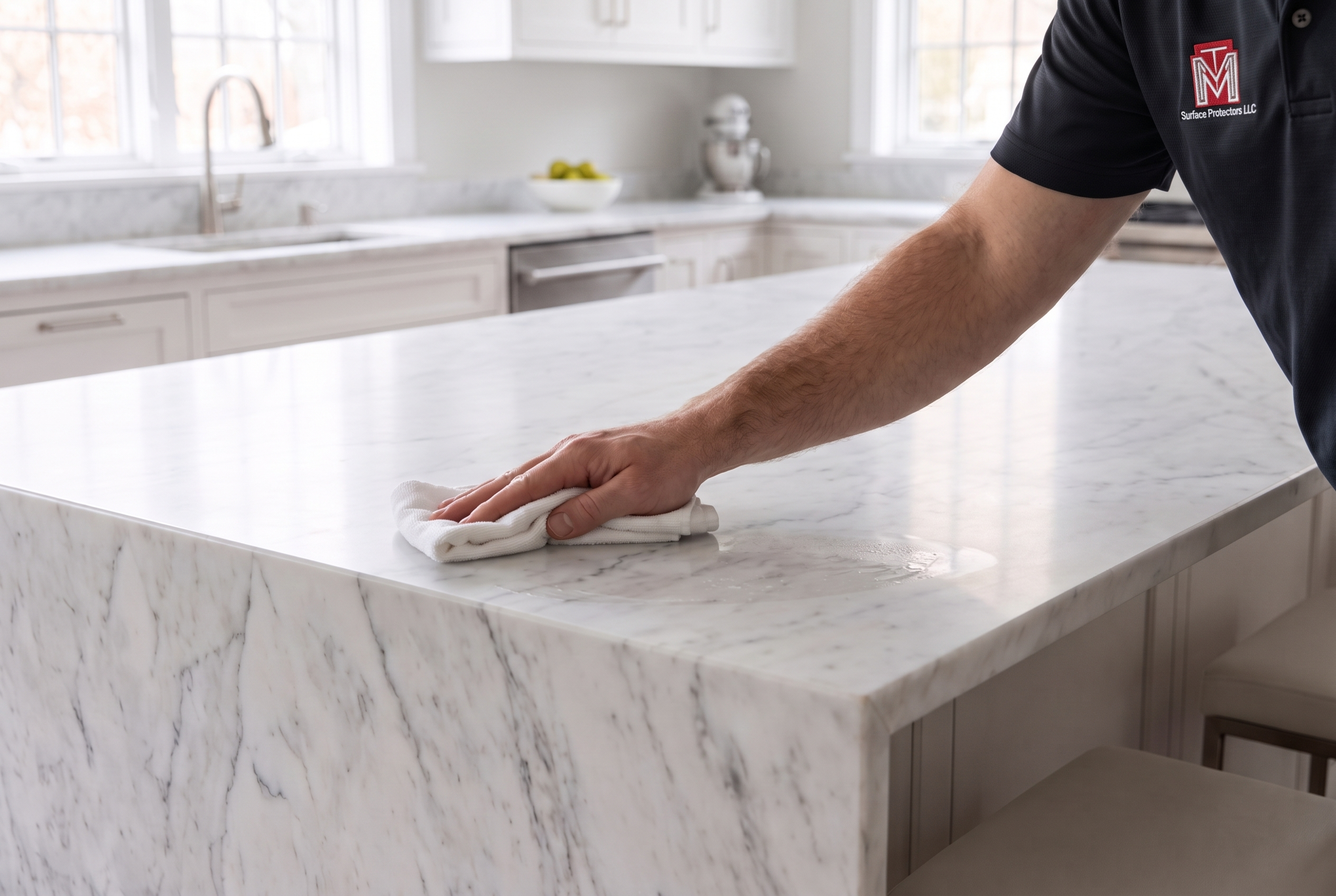
How do I choose the right marble sealer for my kitchen?
Start with the problem you are trying to solve.
If you are worried about oil or water darkening the marble, ask whether the stone is currently absorbing liquid. A penetrating sealer may help. If you are worried about dull spots from lemons, cocktails, or tomato sauce, sealer alone will not solve that problem.
Also consider the size and shape of the countertop. A small, simple surface may be manageable as a careful DIY project. Large islands, waterfall edges, sinks, seams, and existing damage are good reasons to ask a stone professional first.
Be cautious with any simple penetrating sealer that claims to make marble acid-proof. Marble contains calcite, which reacts with acid. The mark left by that reaction is etching, not a stain.
Can I seal marble myself?
You can! Just make sure to follow the manufacturer’s directions and here are some tips:
- Clean the surface gently. Use a pH-neutral stone cleaner and a soft cloth. Do not use vinegar or bleach.
- Let the marble dry. Follow the sealer instructions for surface preparation and drying.
- Test a hidden spot. Check for darkening, streaking, or a change in sheen.
- Apply the sealer as directed. Keep the application even and respect the stated dwell time.
- Allow the full cure time. Keep water, cleaners, and food off the surface for as long as the label requires.
StoneGuard and anti-etch coatings are not penetrating sealers. StoneGuard is a removable film that requires careful fitting around edges, sinks, and seams. Anti-etch coatings are bonded systems with a different installation and renewal process.
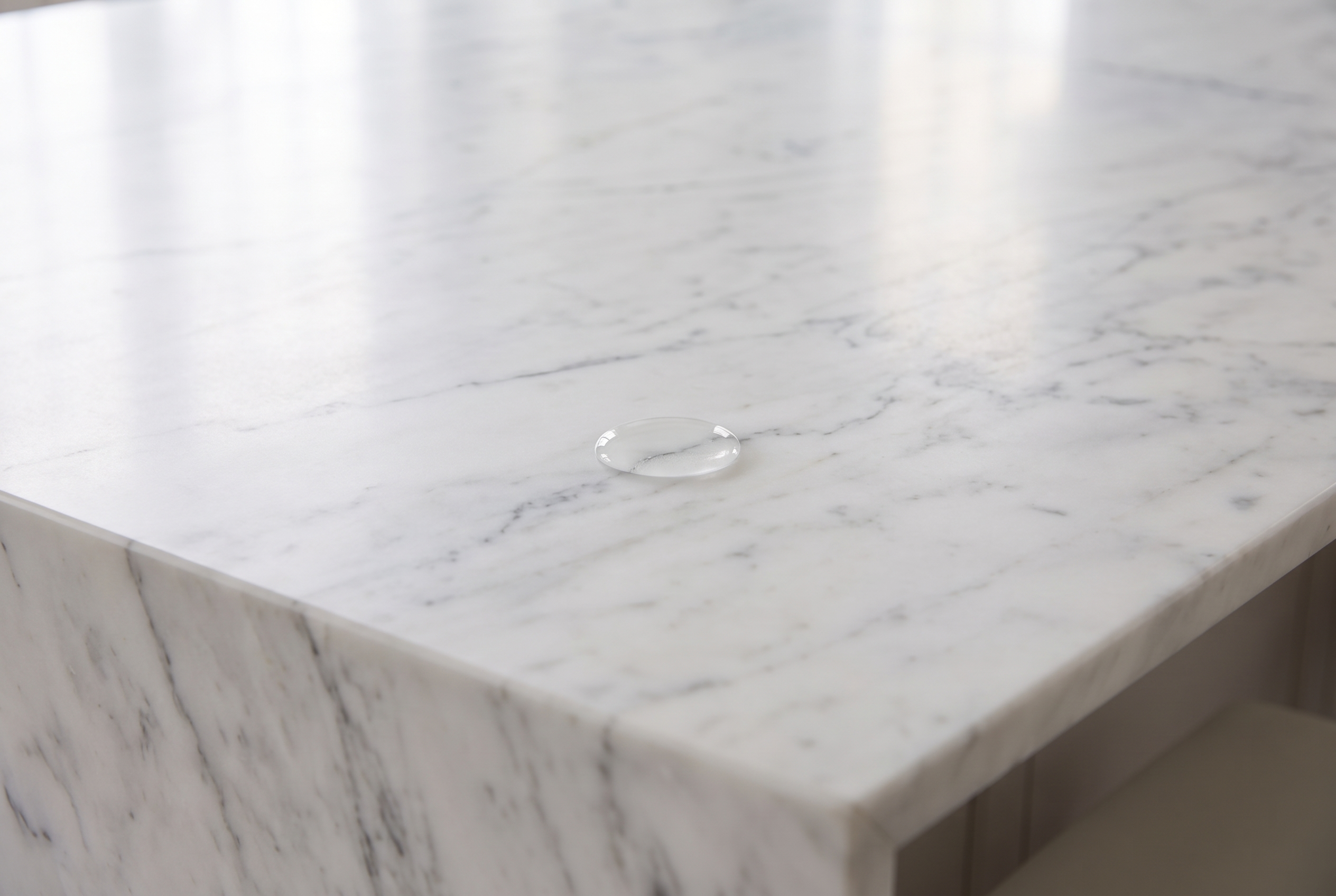
How do I know when marble needs sealing?
Do not reseal only because a certain number of months or years has passed. Check how the marble behaves.
On a clean, dry, hidden area, place a small drop of water and leave it for the time recommended by your stone or sealer professional. Wipe it away. If that spot darkens, the stone may be absorbing moisture and may need sealing. Test carefully because oils can leave a stain on unprotected marble.
High-use areas near a sink or prep zone may behave differently from the rest of the countertop. A professional can assess those areas during a routine service visit without assuming the whole kitchen needs the same treatment.
What to avoid
- Do not use acidic or abrasive cleaners on marble.
- Do not apply sealer over wax, polish, oil, or cleaning residue.
- Do not mix products without checking compatibility.
- Do not leave puddles or a shiny layer of penetrating sealer on the surface.
- Do not treat a dull etch mark as though it were a stain.
When to call a pro
A dark spot may be a stain. A dull or cloudy spot is more likely an etch. If you can feel a scratch, see a crack near a seam, or cannot identify the damage, stop experimenting before aggressive cleaning makes the finish harder to restore.
A stone professional can tell you whether the marble needs cleaning, stain removal, honing and polishing, sealing, or a removable protective film.
Frequently asked questions
Does sealing marble stop etching from acids?
No. A penetrating sealer helps slow oil and water from soaking into marble, but it does not stop the acid reaction that causes etching.
What is the best way to protect marble countertops from etching?
Keep acidic spills off the stone, clean them promptly, and use cutting boards and coasters. If you want stronger protection, a physical barrier such as StoneGuard prevents acids from touching the covered marble.
Is StoneGuard better than an anti-etch coating?
They are different systems. Anti-etch coatings are bonded to the surface and may require restoration-level refinishing when renewed or removed. StoneGuard is a removable film. It can be replaced while leaving the marble beneath untouched. It is also scratch-resistant, not scratch-proof.
How often should I reseal marble countertops?
There is no single schedule for every countertop. Reapply a compatible penetrating sealer when testing shows that the marble is absorbing again, following the product instructions and your stone professional’s guidance.
How much does marble protection cost in NYC?
Cost depends on the condition, square footage, edges, cutouts, access, and protection system. An assessment is the right way to compare sealing, restoration, and protective film for your countertop.
Get a local assessment
If you are in New York City or northern New Jersey and are not sure what your marble needs, send M&T Surface Protectors one clear photo or short video. We will help you sort out whether you are seeing a stain, an etch, or a sealing issue, then recommend the right next step. You can learn more about our work at M&T Surface Protectors and review more marble care guidance on our Learn page.