

Quick answer
- A sealer slows stains, not etching. A penetrating sealer sits in the pores of honed marble and buys you time to wipe a spill. It does nothing against the dull marks that lemon, wine, and vinegar leave behind, so you are still the one watching your countertops 👀
- Etching is the bigger risk on a honed surface. The matte finish hides small flaws well, but a new etch reads as a texture change against it, so it shows more than you would expect.
- Do the water test first. Ten minutes with a few drops of water tells you whether the sealer is still working.
- For a kitchen you actually cook in, film is the more complete answer. StoneGuard Satin from M&T Surface Protectors is a removable protective film made for honed and matte stone. It covers the surface so spills sit on the film instead of reaching the marble, which means you can host, cook, and pour without thinking about it 🍷
- Sealer is a fair interim step. A quality sealer on a lightly used surface is reasonable if you are not ready for film.
Start here: sealing your stone
Sealing is the first thing most honed marble owners are told to do, and it is worth understanding what it does before you spend a Saturday on it. A penetrating sealer soaks into the pores of the stone and slows how fast liquids get in. It does not sit on top, it does not change the look, and it does not stop acid from reacting with the marble. Think of it as a head start on wiping up a spill, not a shield. The spill you catch in five minutes is fine. The one you find after the guests leave may not be 😬
The good news is that you can check in ten minutes whether your stone even needs it.
The water test
Put a few drops of water on the busiest part of the counter, wait ten minutes, and wipe.
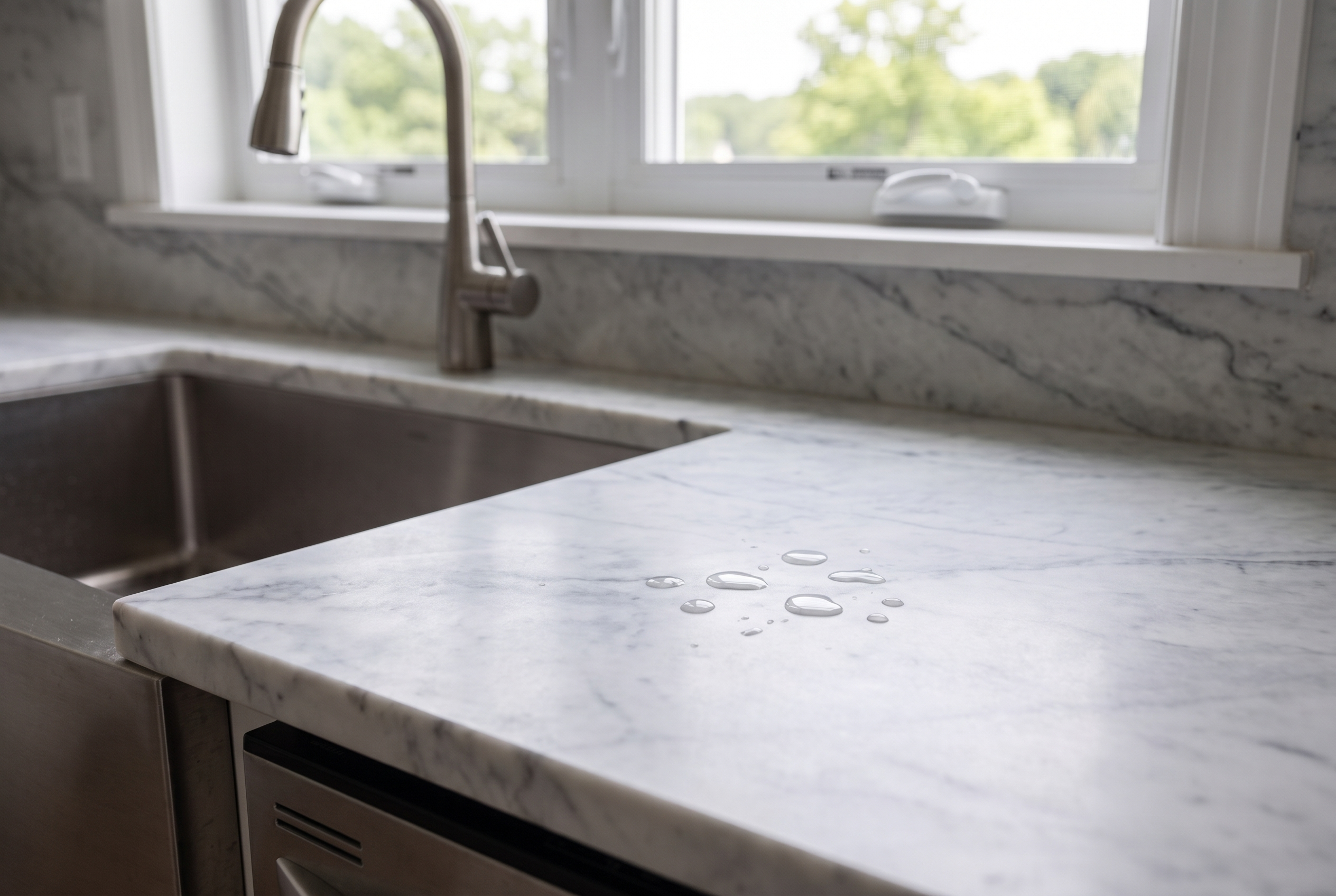
- The water beads and wipes away clean: the sealer is still working. Staining is slowed for now. Etching is still possible, because no sealer blocks acid.
- The water leaves a dark patch that fades in a few minutes: the stone is absorbing. The sealer has worn thin or was never applied. Plan to reseal soon, or move to film.
- The dark patch stays for an hour or more: the marble is fully open. Oil, coffee, and wine can leave real stains. Protect it before the next dinner party.
Pro tip: test the sink strip and the spot beside the cooktop, not the far end of the island. Those zones see the most water and the most acid, and they are where the sealer wears first.
The #1 thing people get wrong: a stain is not an etch
Most honed marble owners call every mark a stain, then buy a sealer that cannot fix the mark they actually have. The two problems have different causes and different fixes.
- A stain is absorption. A liquid soaked into the pores and left color behind. Coffee, red wine, and cooking oil are the usual causes. A sealer slows this, and a poultice can often draw it back out.
- An etch is a chemical reaction. Acid dissolved a thin layer of the marble surface. On polished stone it looks like a dull spot. On honed stone it looks like a patch with a slightly different texture. No sealer prevents this, because the acid reacts with the stone whether the pores are sealed or not.
Stains point to sealing and cleaning habits. Etching points to a physical barrier between the acid and the stone, which is what a protective film is.
How to protect honed marble: 4 steps
Step 1: Clean and dry the surface completely
Wipe the counter with a pH-neutral stone cleaner or warm water and a soft cloth. Skip vinegar, citrus cleaners, and anything abrasive, because those etch the finish you are trying to protect. Let the stone dry fully before any product goes on, since trapped moisture keeps a sealer from bonding.
Step 2: Seal only if the water test says the stone is open
If water soaked in during the test, apply a penetrating sealer made for natural stone and follow the label for dwell time. If water beaded, sealing again adds nothing.
Step 3: Wipe the excess before it dries, which is where people go wrong
The sealer needs a few minutes to soak in, but any product left sitting on top will dry into a haze that is hard to remove on a matte finish. Wipe the surface completely with a clean dry cloth once the label's dwell time is up. If a haze appears, apply a little more sealer to soften it and wipe again right away.
Step 4: Decide whether the high-use zones need film
Sealing does not change etching risk. Look at the zones where you cut citrus, set down wine glasses, and cook. Those are where a removable film like StoneGuard Satin earns its keep, because it covers the stone so acids never touch it and those zones stop being the ones you worry about. The next two sections walk through what that looks like.
Do not forget the cooktop strip and the sink cutout
The strip beside the cooktop and the rim of the sink cutout take more abuse than the rest of the counter combined. If you protect only the island top and leave these zones bare, that is where the first etch and the first stain will appear.

What the film option actually looks like
If you have been sealing for a while and still find new marks, this is the part most people have not heard explained plainly.
What StoneGuard Satin is. It is a removable protective film that M&T installs directly on the finished countertop. It is not a sealer that soaks in and not a coating that bonds to the stone. It lies on top of the marble, so a spilled glass of wine or a squeeze of lemon sits on the film and never reacts with the stone underneath. No ring under the glass in the morning, no dull patch where the lemon rolled. Satin was tuned for honed and matte finishes, so it keeps the soft, tactile look you chose instead of adding gloss, and it brings out depth and color that can wash out in daylight on bare sealed stone.
Is it a DIY product? No. Sealing can be a homeowner job, and if you would rather not take it on, or you are worried about getting the haze or the dwell time wrong, M&T can come and seal the stone for you as well. StoneGuard is different: it is a professional installation by M&T's certified installers, because the film has to be fitted to your exact counter, including the sink cutout, the cooktop strip, and the edges, and applied without trapped dust or bubbles. You do not need to prep anything beyond clearing the counters. We come to you, and you have your kitchen back the same day.
Living with it. Day to day you clean it the way you would clean any countertop, with a soft cloth and a mild cleaner. You can set down glasses, cook, and wipe up spills without watching the clock. The film handles everyday wear well, but treat it like the stone it protects: use a cutting board rather than cutting directly on the surface, since a knife pressed hard enough can score the film, and use a trivet for oven-hot cookware just as you would on bare marble.
When it is time for a change. Because the film is removable, it comes off and a fresh one goes on, and the marble underneath is left exactly as it was the day the film was installed. Nothing is ground, honed, or refinished, and you never lose the finish you fell for in the showroom. That is the real difference from sealing: a sealer buys you time between stains, while the film is how you keep honed marble looking the way it looked on installation day.
Sealer or StoneGuard Satin: which fits your kitchen?
| Option | What it does | How it is renewed | Who it suits |
|---|---|---|---|
| Penetrating sealer | Slows staining so a spill can wait a few minutes for you. Does not stop etching. | Reapply when the water test fails. | Lightly used surfaces, or a first step before film. |
| StoneGuard Satin film | Keeps spills and acids off the stone, so the marble stays as installed and stops being something you think about. Made for honed and matte finishes. | Removable. The film is replaced and the stone underneath is left untouched. | Kitchens that are cooked in daily, and new honed marble you want to keep exactly as installed. |
Both have a place. Many of our customers like to protect their entire kitchen with film, and depending on how worried they are, they will protect their powder rooms as well. For those who are not as worried about their bathrooms, we often seal them instead.
How often to reseal, and when to call a pro
The typical recommendation is to reseal every 6 to 12 months, but there is no honest fixed schedule for honed marble. It really depends on the stone and how the counter is used, and the right interval can be shorter or longer than that. The water test is the schedule. Run it every few months on the busiest zone, and reseal when water starts to soak in.
Factors that shorten the interval:
- Daily cooking with citrus, tomato, and wine near the counter.
- Harsh cleaners, which strip sealer and etch the stone at the same time.
- A sink or cooktop cutout, where water and heat sit on the same strip all day.
- Light-colored stone, which shows stains sooner and needs the sealer working.
Call us when a mark does not wipe away with a neutral cleaner, when the surface has a patch that feels or looks different in raking light, or when you are deciding between sealing and film before a kitchen goes into heavy use. We would rather look at a photo than have you scrub a honed finish with the wrong product 🙂
Frequently asked questions
Does a sealer stop etching on honed marble?
No. A sealer slows staining by reducing how fast liquids absorb into honed marble, but a sealer does not block acid, so etching can still happen on sealed stone.
Will StoneGuard change how my honed marble looks?
StoneGuard Satin was engineered for honed and matte finishes rather than to add shine, so the goal is to preserve the look you chose for your honed marble, not change it.
Can I install StoneGuard on honed marble myself?
No. StoneGuard is fitted and installed by M&T's certified installers so the film matches your counter exactly, including cutouts and edges. Sealing is the part you can do yourself.
Can I put StoneGuard on honed marble that already has some wear?
Yes, in many cases. A consult confirms whether the film can go over the existing honed surface or whether the stone should be restored first so the film locks in a clean finish.
How do I remove sealer haze from honed marble?
Apply a small amount of the same sealer to soften the dried residue, then wipe the honed marble immediately with a clean dry cloth. Do not use abrasive pads on a honed finish.
Is honed marble more prone to etching than polished marble?
Honed marble etches at the same rate as polished marble, because the chemistry is the same. The difference is how the etch shows: on honed marble it reads as a texture change instead of a dull spot.
Related guides
- The best sealer for marble, and what it can and cannot do
- How to protect marble from etching without ruining the look
- How StoneGuard Satin is applied
- Before and after: StoneGuard on real kitchens
Questions about your honed marble?
If you are in New York City or northern New Jersey and are not sure whether your honed marble needs a sealer, a film, or a repair first, send us a photo or a short video. We will give you an honest read on what the stone needs, even if the answer is that you do not need us yet.