

Are there marks showing up after you’ve hosted a dinner party? Or even after a cleaner you have used a hundred times?
Or after you finally stopped noticing it, until the morning light hit the counter at exactly the wrong angle.
That is often how marble etching shows up. Quietly, and then all at once when you notice it.
The good news is that an etch is often repairable. The more useful thing to know is that not every mark needs the same response.
The short answer
Marble etching is a dull, cloudy, or rough area where acid has changed the surface of the stone. It is not a stain sitting in the pores.
Small, isolated etches can sometimes be improved carefully. Large areas, repeated damage, roughness, or a finish that no longer matches the rest of the countertop usually call for professional honing and polishing.
Before you buy another cleaner, it helps to identify what you are actually looking at.
Stain or etch: the question that saves time
A stain tends to make marble look darker. Oil, coffee, wine, and other materials can soak into the stone.
An etch changes how light reflects from the surface. On polished marble it can look white, hazy, or dull. On honed marble it can look like a pale spot or a change in texture.
Here is a useful rule: if the mark looks clean but still looks wrong, it may be an etch.
Acidic foods and cleaners are common causes. Lemon, vinegar, wine, tomato sauce, and some bathroom or descaling products can all be part of the story. Marble is calcium-based stone. Acid reacts with its surface.
That is chemistry, not carelessness.
When you can leave it alone
Not every etch is an emergency.
A small mark in a quiet corner may simply be part of the patina you are comfortable living with. Some homeowners prefer that choice. Marble is a natural material, and a kitchen used every day will tell a story.
Leave it alone for now if:
- The mark is small and smooth.
- You only notice it at a certain angle.
- The finish around it still feels even.
- You are not ready to refinish the broader area just to remove one spot.
There is no need to rush into a repair just because the mark is bothering you today.
When a professional repair is worth it
You may want to call a stone restoration professional when the etching is broad, rough, repeated, or sitting somewhere you see it every day.
That includes:
- Dull rings across an island or bar top.
- Etching around a sink or on a main prep area.
- A spot that catches a fingernail or feels different from the surrounding finish.
- Many small marks that have turned the whole surface uneven.
- A repair that needs to blend into a large polished or honed area.
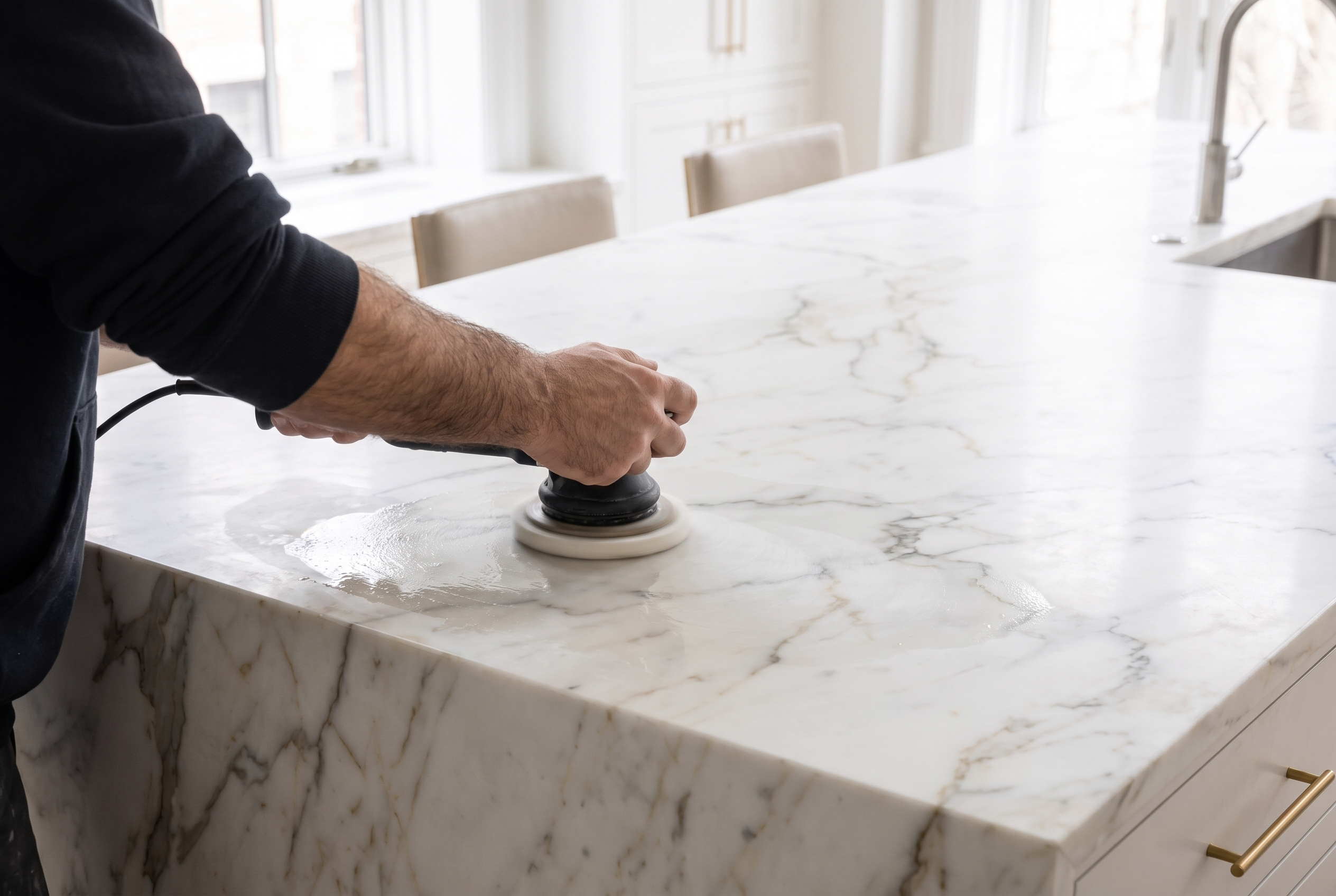
Professional restoration typically uses honing and polishing to bring the surface back to a consistent finish. The work is about blending, not merely removing one mark. The aim is to make the countertop look coherent again.
A good contractor will ask what stone you have, whether it is polished or honed, what caused the damage, and what result you expect. They should not promise an invisible result before seeing the surface.
Why most DIY fixes go wrong
DIY advice often treats marble like a countertop that needs stronger effort.
It is the opposite.
A rough pad, generic polishing powder, or random sanding kit can leave a small etch with a larger, more obvious patch around it. On polished stone, matching the original shine is particularly difficult. On honed stone, a repair can create a polished spot if the method is wrong.
A careful test on a tiny, hidden area can make sense. We just would not want a small concern to turn into a larger finish problem.
If the mark is in the center of a prominent island, send a photo before you touch it.
What repair does, and what it does not do
Repair can restore an even surface.
It does not make marble immune to the next lemon, wine spill, or acidic cleaner.
After restoration, you have a few honest choices:
- Accept normal patina and use simple care habits.
- Add a penetrating sealer if stain resistance is the need.
- For a high-use countertop where you want a removable barrier from acid and everyday wear, consider StoneGuard®, the stone-protection film M&T installs.
StoneGuard® is scratch-resistant, not scratch-proof. Use boards and trivets. The value is that it is removable and replaceable, while the marble beneath remains untouched.
The next useful step
If you want an opinion, take one clear photo in daylight and another with light glancing across the surface. Include a wider shot so the finish around the mark is visible.
That tells us far more than a product name or a description of “a white spot.”
If you are in NYC, Long Island, North Jersey, or eastern Pennsylvania, send those photos to M&T Surface Protectors. We will tell you whether the right answer is to leave it alone, clean it, restore it, or protect it after repair.
There is no pressure. We just want to help you make the next decision with a little more confidence.