

StoneGuard® vs anti-etch coating vs sealer: how to remove stains and protect your stone

There are three questions hiding inside most countertop-protection questions.
Can this mark be fixed?
How do I keep it from happening again?
And what will I have to live with after I choose?
The last question may matter most. Your countertop is not a sample board. It is where you make coffee, cut a lemon, and put down a glass when you are talking to someone you love.
The short answer
A sealer, an anti-etch coating, and StoneGuard® are not interchangeable.
A penetrating sealer helps slow staining. It does not repair existing damage or stop acids from etching marble.
An anti-etch coating is a bonded surface system. It creates a protective layer on the stone, but it is a different system with its own appearance, maintenance, and restoration-level renewal.
StoneGuard® is the removable film M&T installs for natural stone. It creates a barrier over the stone and can be replaced later while leaving the marble beneath untouched.
None of the three removes a stain or an etch that is already there. If there is existing damage, it helps to identify it and address it first.
First, solve the problem you have
A darkened area may be a stain. A dull, pale, or rough area may be an etch.
Those need different responses.
A stain is often something that has absorbed into the stone. Depending on its cause and depth, it may respond to proper cleaning or a poultice.
An etch is a physical change in the marble surface, usually from acid. It may need honing and polishing to return the finish to an even appearance.
Protection is a decision about the future. Restoration is a decision about the present. Mixing those two decisions leads to bad expectations.
What a penetrating sealer is for
A penetrating sealer works in the pores of the stone. It helps slow the absorption of water and oil-based spills.
That buys you time. For a low-use surface, it may be exactly what you need.
It does not form a barrier that stops acid from reaching marble. A sealed marble countertop can still etch from lemon, vinegar, wine, and acidic cleaners.
We recommend a sealer when stain resistance is the real goal. We do not position it as etch protection.
What an anti-etch coating is for
An anti-etch coating is a bonded top layer applied to the stone. It is not a sealer. It is not StoneGuard®.
It can be a fit for a homeowner who wants a permanent surface system and accepts the care requirements that come with it. It can also change sheen, feel, or appearance, depending on the product and the stone.
The trade-off is future work. If a coating is worn or damaged, renewing or removing it becomes restoration-level work because the coating has to be removed and refinished. Coatings can also show scratches. They are not scratch-proof.
That is not meant to steer you away from a coating. It is simply part of the conversation worth having before you commit.
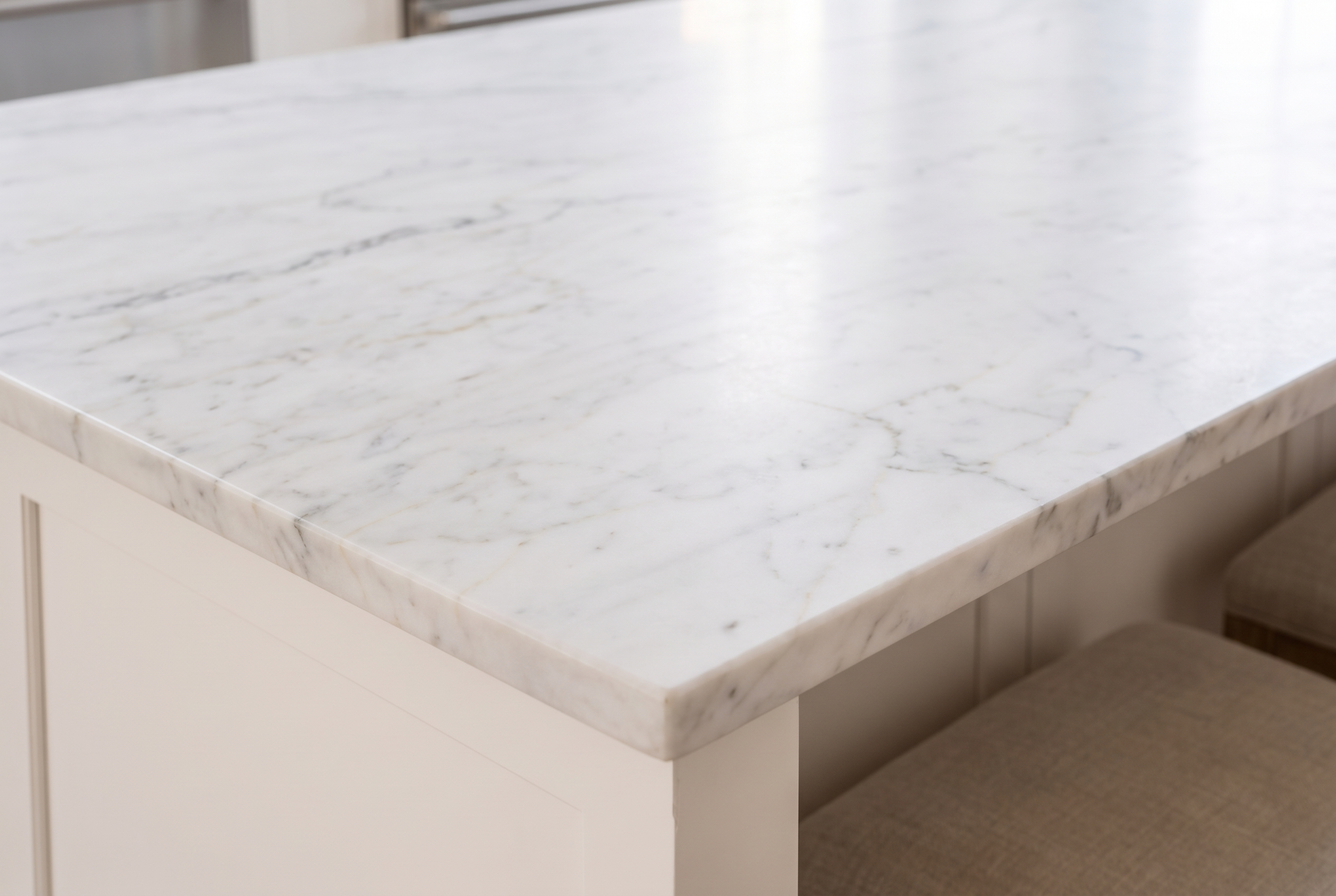
Ask for a sample on the exact stone you own. Ask how the surface will look in daylight. Ask how damage is repaired. Ask what happens years from now.
What StoneGuard® is for
StoneGuard® is a clear, removable film engineered for natural stone. M&T installs it on qualifying natural-stone countertops.
It is not a sealer. It is not an anti-etch coating.
It creates a physical layer over the stone. The film is scratch-resistant and designed to protect against everyday scuffs and wear, but it is not scratch-proof. Cutting boards and trivets still belong in a real kitchen.
When the film needs replacement, the replacement work is on the film, not on the marble beneath it.
That is why we recommend it for homeowners who want a removable protection layer and want to preserve the original stone surface.
The practical comparison
| Option | What it does | What it does not do | Future consideration |
|---|---|---|---|
| Penetrating sealer | Helps slow water and oil staining | Does not stop etching or remove existing damage | Needs periodic performance checks and reapplication as needed |
| Anti-etch coating | Creates a bonded protective surface layer | Does not remove existing damage and is not scratch-proof | Renewal or removal involves restoring the coated stone surface |
| StoneGuard® | Adds a removable barrier over qualifying natural stone | Does not repair existing etches or make the surface scratch-proof | Film can be replaced while leaving the stone beneath untouched |
The best choice depends on your stone, its finish, how you use the room, and how you would like to handle maintenance down the road.
For some homeowners, a sealer and better habits are enough. For others, a bonded coating may be worth its permanence. If you want a removable layer, you may want to consider StoneGuard®. It is the film we install on natural stone, including marble.
A note about other films
If another company offers a film, ask what film it is and whether it was engineered for natural stone.
A film designed for another surface may not be right for stone and can create risks. That is not a reason to assume the worst. It is a reason to ask a precise question before a precise surface is covered.
We are clear about the answer: we install StoneGuard®, a film made for natural stone.
Start with the counter, not the product
The best protection conversation begins with your actual countertop.
What stone is it? Is it polished or honed? Is the issue a stain, an etch, or both? Do you enjoy a little natural patina, or does every new mark create stress?
Those answers usually matter more than a product label.
If you are in NYC, Long Island, North Jersey, or eastern Pennsylvania, send M&T Surface Protectors a few photos. We will tell you what we see, what each path asks of you, and whether you need us at all.
That is a good place to start.